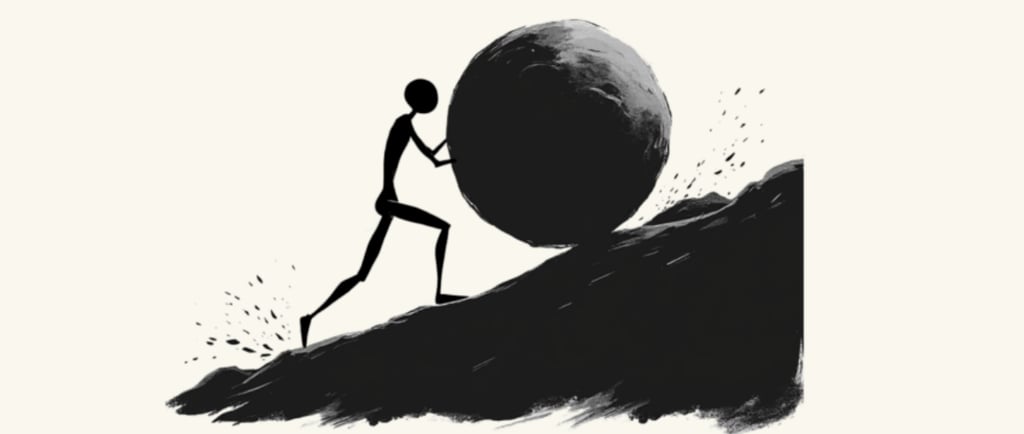
AI is making life frictionless. Creation, learning, communication, and production are becoming faster, cheaper, and more accessible than ever before. The distance between an idea and an outcome is collapsing. A thought can become a paragraph, an image, a song, or a plan almost instantly, and we’re seeing that for many people, this raises an obvious fear: if effort disappears, so does meaning. If machines can do everything better than us, faster than us, what’s left for humans?
I argue that humans don’t become fulfilled in ease. Historically, when friction disappears, we recreate it. Comfort increases, yet meaning becomes harder to find, unless friction becomes something we choose. That tension sits at the center of this moment. The real question is not whether AI removes effort, but what happens after it does. The mistake is assuming that effort only matters when it’s required. For most of human history, difficulty didn’t say much about who you were. You didn’t choose it; you endured it. Survival demanded effort by default. But AI changes the nature of effort by removing its necessity. When machines can produce faster, cheaper, and often better than humans, doing something yourself is no longer required for survival, income, or status in the same way. That shift, from necessity to choice, changes everything.
To understand why, it helps to define friction clearly. Friction is effort, time, repetition, constraint, and resistance. AI removes baseline friction from the path between idea and output. Writing, designing, coding, learning, and translating, these no longer require the same level of labor they once did.
Most importantly for this argument, AI doesn’t remove all friction from life. It removes required friction. What’s left is optional friction. And optional friction is where meaning begins to reappear. Humans evolved in environments where effort was built into survival. Walking long distances, carrying loads, learning through repetition, and building shelter made friction unavoidable. Modern systems strip much of that away, creating a mismatch between how our minds and bodies evolved and how we now live. When systems remove effort, humans don’t settle into ease forever. We invent new forms of effort. We train, practice, build, and repeat. This is because friction is how we experience agency and growth.
This is where AI becomes unexpectedly beautiful. Choosing difficulty becomes an expressive action. Doing something hard becomes more about who you are and your identity than about productivity and what you contribute to society. You’re not doing the thing because you have to. You’re doing it because you love it; this reframes effort from friction-as-survival to friction-as-love.
Psychologically, effort changes how we relate to outcomes. There’s a well-documented effect called the IKEA effect, where people value things more when they’ve put labor into them, even if the result is objectively worse. The work embeds itself in the outcome. You don’t just see the thing, you see yourself in it. Friction also forces presence. You can’t fully autopilot something difficult; you have to be there in the moment, or the result changes. Effort demands attention, and attention is a huge part of what people mean when they say something felt “real.” Over time, repeated resistance builds self-trust. Moving through difficulty gives your brain proof: I can do hard things. Without those repetitions, meaning thins out.
When effort becomes optional, choosing it also becomes visible to others. In a world where output is cheap and abundant, effort becomes scarce. What you choose to struggle for starts communicating who you are and what you value. This is what sociologists describe as cultural capital: the tastes, habits, and practices that signal distinction. AI improves signal clarity by removing noise. If anyone can post, generate, or produce, the differentiator becomes practice. Effort becomes a readable signal of identity.
In addition to how individuals experience meaning, this shift reshapes relationships. Many modern bonds are built around consumption: shared shows, shared tastes, shared opinions. Consumption-based bonding is low-friction, fast, and inclusive, making it a great entry point. Watching a show together, following the same artist, and wearing the same brands can strengthen relationships, especially when trust already exists. But consumption is a weak foundation because taste changes. When a bond is built primarily on sameness, difference feels like a threat.
Practice-based bonding works differently. When people do something together (train, make, write, sew, run, build), the bond is rooted in process rather than preference. Even when opinions change or styles evolve, the craft remains. The difference actually becomes fuel for innovation, and disagreement turns into learning. Relationships rooted in shared practice don’t break when tastes change; they deepen because growth requires difference. (This is what irks me so much about modern relationships and communication. When people believe two different things, there is no constructive conflict; we skip authentic conversations and go directly towards actions meant to tear each other down.)
Effortful experiences are also important at a collective level. When people struggle, train, or practice together, something emerges that’s thicker than shared consumption. There’s a sense of energy, unity, and meaning that comes from doing hard things together. Communities form because people repeatedly do the same things. This commitment is longer than a season of Stranger Things or the piece of clothing that you’ll stop wearing after a month. The run club. The studio. The workshop. The gym. These are modern tribes organized around chosen friction, and the work itself becomes the glue.
AI doesn’t eliminate these communities. It can support coordination, access, and organization. But the friction lives in the practice, not the tool. The danger comes from mistaking aesthetic struggle for real struggle, or replacing practice with performance. Meaning still requires presence, repetition, and commitment. Friction only works when it’s real. This is why the claim that AI “kills creativity” misses the point. AI threatens creative labor when creativity is tied to output, status, or money. But it liberates creative practice by removing the need to perform. When machines can do anything faster and better, the only remaining reason to do something yourself is because you love it.