Breaking News: He Woke Up and Turned his Swag on Again
Put That Sh*t on Claude
This is about how a meme can tell us something bigger about how we assign authority. It looks at how language shapes trust, why AI is starting to fill roles that religion once did, and why understanding the systems we rely on matters more than we think.
OPINION
Nuri Robinson
7/28/20264 min read
Intro
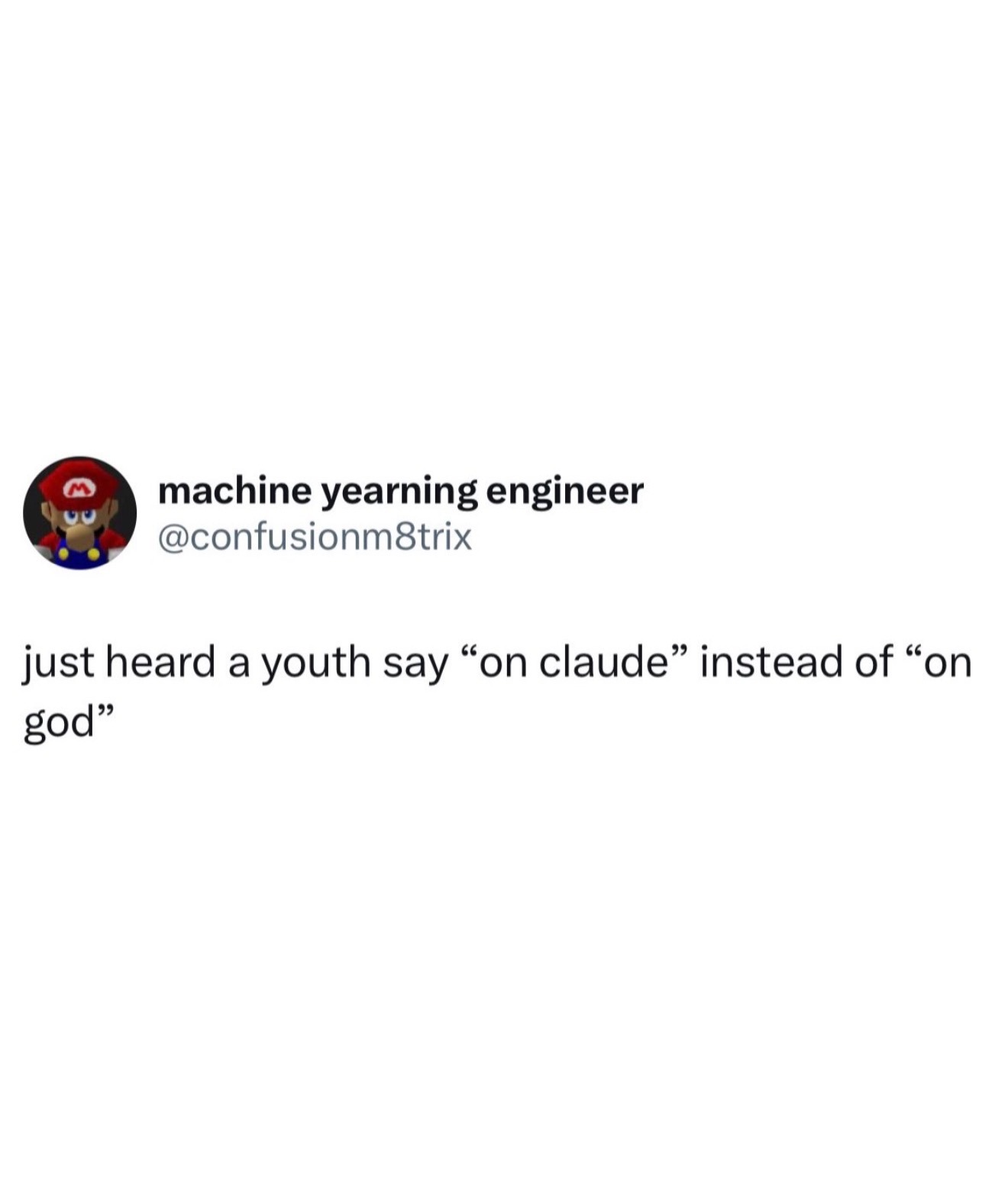
There was a tweet that said, "just heard a youth say 'on claude' instead of 'on god.'" And yes, I laughed. Then I got hit with this weird punch of despair because I could suddenly see where something like this could go.
That phrase pulled a lot of different thoughts together for me. It made me start questioning what a phrase like this does to how we interact with each other, how we interact with AI, and how it connects to religion as we've traditionally understood it. I watched a video arguing that AI is beginning to take on some of the social roles religion once filled, and this tweet felt like another proof point.
I know the obvious response is, "It doesn't mean anything. It's just a meme." And maybe it is. But we live in a world where a huge amount of culture happens online. And I truly believe that memes shape the language people use, and language shapes how people think. So yes, this is only one small data point, but I think it's a useful one. I want to use it to look at how language assigns authority, and why understanding the mechanisms behind the jokes we make matters if we don't want to hand authority over to the things we think are helping us.
What an Oath Actually Does
To understand why "on Claude" matters, you first have to understand what a phrase like "on God" actually does. I'm pulling from J.L. Austin's speech-act theory, which argues that some sentences act on reality. This boils down to: words are more than words, and they can become actions. For example, if the President says, "I declare war," a war will happen; they create a new social reality. Austin called these performative utterances. "On God" works similarly.
When people say "on God," they're usually not making a theological argument or trying to prove God's existence. They're swearing an oath to a higher authority. They're saying, "I'm telling the truth, and I'm willing to go to hell if I’m lying." You see the same thing with phrases like "wallahi" or "put that on your mother." Whether the speaker is religious isn't really the point. The phrase works because everyone involved understands that it designates truth.
Now think about "on Claude." It fits into the exact same grammatical slot. It sounds familiar. And everyone immediately understands what it means. Saying "on Claude" implies that if you checked Claude right now, it would back up what I just said. The phrase skips over the actual fact-checking because it assumes Claude already represents the truth. That is a very important shift.
Historically, many of the things people put "on God" couldn't actually be verified. "Did you actually tell him that?" "Yeah." "Put that on God." The point wasn't that God would instantly appear and verify the claim. The point was that both people accepted an authority that couldn't be independently checked. "On Claude" changes the nature of that authority. Instead of appealing to moral or divine authority, it appeals to computational authority. It assumes that Claude has the answer and that its answer is worth trusting.
Again, I know it's a joke. But speech acts only work because enough people collectively agree that they do. The more a phrase gets repeated, the more normal the assumption behind it becomes. Over time, "on Claude" reinforces the idea that AI outputs are authoritative.
Why Mystery Is Part of the Mechanism
But authority isn't only about claiming to know the truth. Historically, authority also depends on a lack of full understanding of how it works. You can't really treat something as all-knowing if you completely understand every mechanism behind it.
Religion has always contained an element of mystery. God's actions aren't fully knowable. The same thing happens with "the algorithm." Most people don't know how recommendation systems actually work or why certain posts get promoted while others disappear. All they know is that if they behave in certain ways, they might get different outcomes. When a system is opaque, people naturally begin building explanations around it. "The algorithm likes consistency." "The algorithm punishes links." "The algorithm wants watch time." Some of these are true. Some aren't. But once the system becomes mysterious, people start changing their behavior based on stories about how it works.
This has been happening for years; authority and incomprehensibility have often traveled together. You can see it in oracles, scripture, legal systems, financial markets, and, increasingly, in AI. The less people understand the system itself, the easier it becomes for the system (and those who control the system) to occupy a position of authority.
What Fills the Gap When You Don't Understand the Thing
When authority becomes difficult to understand, someone has to explain it. Historically, before most people could read, priests and pastors became the interpreters. Whether intentionally or not, they shaped how people understood reality because they were the ones with access to the source material. The interpreter class looks different today. It's software engineers, machine learning researchers, AI educators, and creators who teach people how to use these systems. Which is not inherently a bad thing; complex systems naturally produce experts. But it creates the same dynamic: when people don't understand the technology themselves, they become dependent on someone else's interpretation. But at some point, you have to learn how to read for yourself. And not because everyone needs to become a machine learning engineer, but because every layer of understanding you gain reduces the amount of authority you have to hand over to someone else.
Conclusion
The phrase "on Claude" is important because it reveals how authority gets reassigned. It shows how language can normalize new sources of trust, how opaque systems create interpreters, and how those interpreters shape what everyone else believes. I think it's worth paying attention to, because the mechanisms hidden inside our jokes often become the assumptions we live by. If we don't understand how those mechanisms work, we start to outsource the decision about what counts as true.